Resources
Worksheets, templates and reference material
Every document here is generated from the canonical Nine M curriculum (version 1.0), so a worksheet you download matches the lesson exactly as it is taught.
Find a worksheet or a term
Filters both the worksheet library and the glossary below.
36 lesson worksheets across nine modules · 113 glossary terms
Workbook and curriculum
Print full editions, or open the editing room behind the curriculum.
Nine M Workbook publishing
Participant and facilitator editions, full workbook, pillar booklets, lessons-only or worksheets-only, US Letter or A4.
Open workbook publishingCurriculum studio
The administrator's editing room for the curriculum itself. Change lesson wording, exercises, evidence requirements, rubrics and scoring, then move the version through review to approved and published — every page, worksheet and PDF in this platform re-renders from those edits. Version 1.0.
Open curriculum studioWorksheets and templates by module
The complete set, in module order M1 through M9 and lesson order within each module. Each download is the real worksheet for that lesson: instructions, inputs, the blank grid and the sign-off block.
M1 Mission
Foundation pillar · rolls into Mission and Strategic Identity Brief
Leadership Alignment Map
Lesson 1: From Doing Church to Living the Mission · 40 minutes · All attending leadership, working individually before group synthesis
To surface each leader's honest, independent understanding of the church's mission before group discussion, and to document where the team currently agrees and disagrees.
Church Fingerprint Statement
Lesson 2: Discovering the Church's Fingerprint · 50 minutes · Full leadership group, including at least two long-tenured lay members
To inventory specific gifts, assets, relationships and demonstrated impact, and synthesize them into a documented statement of the church's distinctiveness.
Alignment and Opportunity Analysis
Lesson 3: Understanding the Community and Priority Audience · 45 minutes · Full leadership group, with outreach and missions leaders taking a lead role
To document current community demographic, psychographic and relational information and compare it honestly against current ministry activity to reveal alignment and gaps.
Three-year vision, twelve-month priorities and Mission Decision Filter
Lesson 4: Turning Mission into Strategic Direction · 60 minutes · Full leadership group
To translate three lessons of mission, fingerprint and community analysis into a concrete three-year vision, a short list of owned annual priorities, a reusable decision filter, and a dated action plan.
M2 Management
Foundation pillar · rolls into Church Management and Accountability Plan
Governance and Authority Map
Lesson 1: Governance, Leadership, and Ministry Operations · 35 minutes · Pastor, board or elder body, senior staff
Give leadership a documented, shared picture of who currently holds spiritual oversight, governance, executive leadership, and daily management authority.
Decision Rights Matrix and Role Scorecards
Lesson 2: Roles, Responsibilities, and Decision Rights · 45 minutes · Pastor, board or elder body, senior staff, key ministry leaders
Assign clear, named ownership across the five decision rights for ten recurring church decisions and document two or three pivotal role scorecards.
Meeting Audit and 30-60-90-day Accountability Dashboard
Lesson 3: Meetings, Accountability, and Execution · 35 minutes · Pastor, board or elder body, senior staff, key ministry leaders
Match the church's meeting structure to real decision needs and build a tracking tool that follows active decisions through to completion.
Key-Person Dependency and Policy Gap Register
Lesson 4: Continuity, Policies, and Leadership Health · 45 minutes · Pastor, board or elder body, senior staff
Identify the church's highest-risk single points of failure and missing policies, and translate them into a prioritized 90-day improvement plan.
M3 Money
Foundation pillar · rolls into Church Financial Health and Stewardship Plan
Ten Financial Questions Visibility Test
Lesson 1: Stewardship and Financial Visibility · 40 minutes · Pastor, treasurer, finance committee, and one or two board members
Establish an honest baseline of what leadership currently can and cannot answer about the church's finances, and assign ownership for closing each gap.
Giving Health Analysis
Lesson 2: Giving Health and Generosity Culture · 50 minutes · Pastor, treasurer, generosity or stewardship team lead, and one board member
Evaluate aggregate giving patterns and translate them into specific opportunities and risks for leadership action.
Twelve-month forecast, operating-runway calculation, three scenarios and draft Reserves Policy
Lesson 3: Budgeting, Cash Flow, and Reserves · 55 minutes · Pastor, treasurer, finance committee, and a board representative
Build a realistic, tested financial operating plan and a written reserves policy leadership can rely on.
Internal Controls Walkthrough and Remediation Register
Lesson 4: Controls, Reporting, and Financial Action · 45 minutes · Pastor, treasurer, financial secretary or counting team lead, and a board member
Document actual financial handling practices, identify control gaps, and assign ownership for closing each one.
M4 Marketing
Attraction pillar · rolls into Church Marketing and Communications Plan
Message Framework document with accompanying insider-language audit
Lesson 1: Marketing as Mission Communication · 30 minutes · Full leadership team plus communications lead
Produce a plain-language Message Framework and identify specific insider phrases in current public copy that need revision.
First-Time-Visitor Digital Audit with barrier log, covering mobile and desktop
Lesson 2: Brand and Digital Front Door · 40 minutes · Leadership team with at least one person navigating live on mobile and desktop
Document specific barriers a first-time visitor would encounter across the church's website, search listing, social channels and visual identity.
Four-week Content Calendar with audience, purpose, channel, owner, call to action and success measure
Lesson 3: Content, Channels, and Calls to Action · 40 minutes · Communications lead with ministry leaders and senior leadership
Plan the next four weeks of church communication with intentional audience matching, channel selection and measurable calls to action.
Campaign Measurement Plan with visitor-source attribution categories and conversion stages
Lesson 4: Measuring Awareness and Response · 30 minutes · Senior leadership, communications lead, guest services or connections team lead
Define how the church will track visitor sources and conversion stages, and establish a review rhythm connecting communication activity to actual outcomes.
M5 Magnification
Attraction pillar · rolls into Sunday Experience Improvement Plan
Guest Journey Map
Lesson 1: Seeing Sunday Through a Guest's Eyes · 30 minutes · Full lesson group
Produce a complete, stage-by-stage map of the guest experience based on a real secret-guest walkthrough, naming friction points and first-draft owners.
Hospitality Role Standards and Checklists
Lesson 2: Hospitality from Parking Lot to Pew · 35 minutes · Full lesson group, divided by role expertise
Write an observable service standard and a companion checklist for every hospitality role in the guest journey.
Service Timeline Review
Lesson 3: Worship Flow and Ministry Coordination · 35 minutes · Full lesson group, organized by service segment
Build a complete timeline of the worship service naming unclear transitions, avoidable delays, participation barriers, and ownership gaps.
Monthly Experience Review design and Accessibility and Safety findings log
Lesson 4: Feedback, Accessibility, and Continuous Improvement · 30 minutes · Full lesson group
Design a recurring monthly review rhythm and document specific accessibility and safety findings with owners and target dates.
M6 Membership
Connection pillar · rolls into Visitor-to-Member Pathway
Current and Desired Belonging Journey Map with stage conversion measures
Lesson 1: Designing the Belonging Journey · 40 minutes · Full membership team in small groups of three to four
Produce a shared, honest picture of how guests currently move toward membership and how leadership wants that journey to work.
Follow-Up Sequence Standards with owners, timing and consent language
Lesson 2: Follow-Up that is Timely and Pastoral · 40 minutes · Connections coordinator, care leader and volunteer leads in small groups
Produce a written, differentiated follow-up standard that leadership can hand to every ministry team.
Orientation Agenda and Membership Expectations Summary
Lesson 3: Membership Expectations and Orientation · 40 minutes · Membership pastor and orientation facilitators in small groups
Produce a usable orientation agenda and a plain-language expectations summary ready for the next membership cohort.
Lapse Signal and Re-engagement Pathway with a monthly funnel review
Lesson 4: Retention, Care, and Re-engagement · 40 minutes · Care ministry leader, small group coordinators and pastoral staff in small groups
Produce a working system for noticing disengagement and responding pastorally, with a recurring leadership review rhythm.
M7 Maturity
Connection pillar · rolls into Discipleship and Maturity Pathway
Maturity Profile
Lesson 1: Defining a Maturing Disciple · 35 minutes · Small table groups of 3-5 ministry leaders
Produce a first draft of observable, stage-appropriate maturity indicators for pastoral review.
Formation Environment Inventory and Pathway Map
Lesson 2: Mapping the Discipleship Pathway · 40 minutes · Ministry leaders working across small groups by ministry area
Catalog every current formation environment and connect them visually into a single discipleship pathway.
Quarterly Maturity Dashboard
Lesson 3: Measuring Participation and Meaningful Progress · 35 minutes · Small table groups of pastoral and ministry leaders
Design a balanced set of participation and pastoral indicators, each with a stated interpretation limit.
Twelve-Month Formation Rhythm
Lesson 4: Building a Culture of Ongoing Formation · 30 minutes · Full leadership group working together or in two larger teams
Assign specific formation improvements, tied to the pathway's three largest gaps, across quarters and integration points.
M8 Ministry
Mobilization pillar · rolls into Member-to-Ministry Mobilization Plan
Ministry Opportunity Catalog
Lesson 1: From Membership to Meaningful Service · 35 minutes · Ministry directors and key ministry leaders, working in small groups by ministry area
Produce a categorized, complete list of every active ministry opportunity so that members can be matched to roles based on gifts and fit rather than availability alone.
Volunteer Journey and Placement Standards
Lesson 2: Discovery, Placement, and Onboarding · 35 minutes · Volunteer coordinator and ministry directors, working together
Create a consistent, documented pathway from initial interest to appropriate placement, with clear ownership and screening standards at each stage.
Volunteer Experience Findings and Retention Actions
Lesson 3: Volunteer Care, Retention, and Development · 35 minutes · Ministry directors, volunteer coordinator, care ministry leader
Surface real, evidence-based retention risks facing the church and assign specific, owned actions to address the three greatest ones.
Ministry Scorecards and Leader Pipeline
Lesson 4: Ministry Effectiveness and Leader Pipeline · 35 minutes · Ministry directors and key ministry leaders
Define real outcome measures for each ministry area and document specific individuals being developed toward future ministry leadership.
M9 Missions
Mobilization pillar · rolls into Missions and Community Impact Plan
Outreach and Missions Inventory
Lesson 1: From Activity to Community Impact · 40 minutes · Missions team, pastoral staff, finance liaison
Create a complete, honest record of current outreach, evangelism and mission-giving activity as the factual baseline for the module.
Community Needs and Assets Map
Lesson 2: Listening to the Community · 40 minutes · Missions team, pastoral staff, invited community contacts
Document community priorities and existing strengths using direct listening and credible data across multiple stakeholder types.
Portfolio Scoring Matrix
Lesson 3: Designing Partnerships and Outreach Portfolios · 40 minutes · Missions team, pastoral staff, finance liaison
Score current and candidate mission commitments on shared criteria to design a balanced, well-governed portfolio.
Community Impact Scorecard
Lesson 4: Measuring and Communicating Impact · 40 minutes · Missions team, pastoral staff, communications liaison
Track outputs, outcomes and learning for the mission portfolio and establish consented-story standards for beneficiary communication.
Module reference
Each module, its pillar and its principal deliverable.
| Module | Group | Principal deliverable | Open |
|---|---|---|---|
| M1 Mission | Foundation | Mission and Strategic Identity Brief | Open |
| M2 Management | Foundation | Church Management and Accountability Plan | Open |
| M3 Money | Foundation | Church Financial Health and Stewardship Plan | Open |
| M4 Marketing | Attraction | Church Marketing and Communications Plan | Open |
| M5 Magnification | Attraction | Sunday Experience Improvement Plan | Open |
| M6 Membership | Connection | Visitor-to-Member Pathway | Open |
| M7 Maturity | Connection | Discipleship and Maturity Pathway | Open |
| M8 Ministry | Mobilization | Member-to-Ministry Mobilization Plan | Open |
| M9 Missions | Mobilization | Missions and Community Impact Plan | Open |
The three Nsites applications
The Nine M curriculum names the questions. These three applications supply the evidence. Perception, evidence and execution stay separate — nothing here is blended into a single Nine M score.
Stewardship Nsites
Leadership, finance team and board
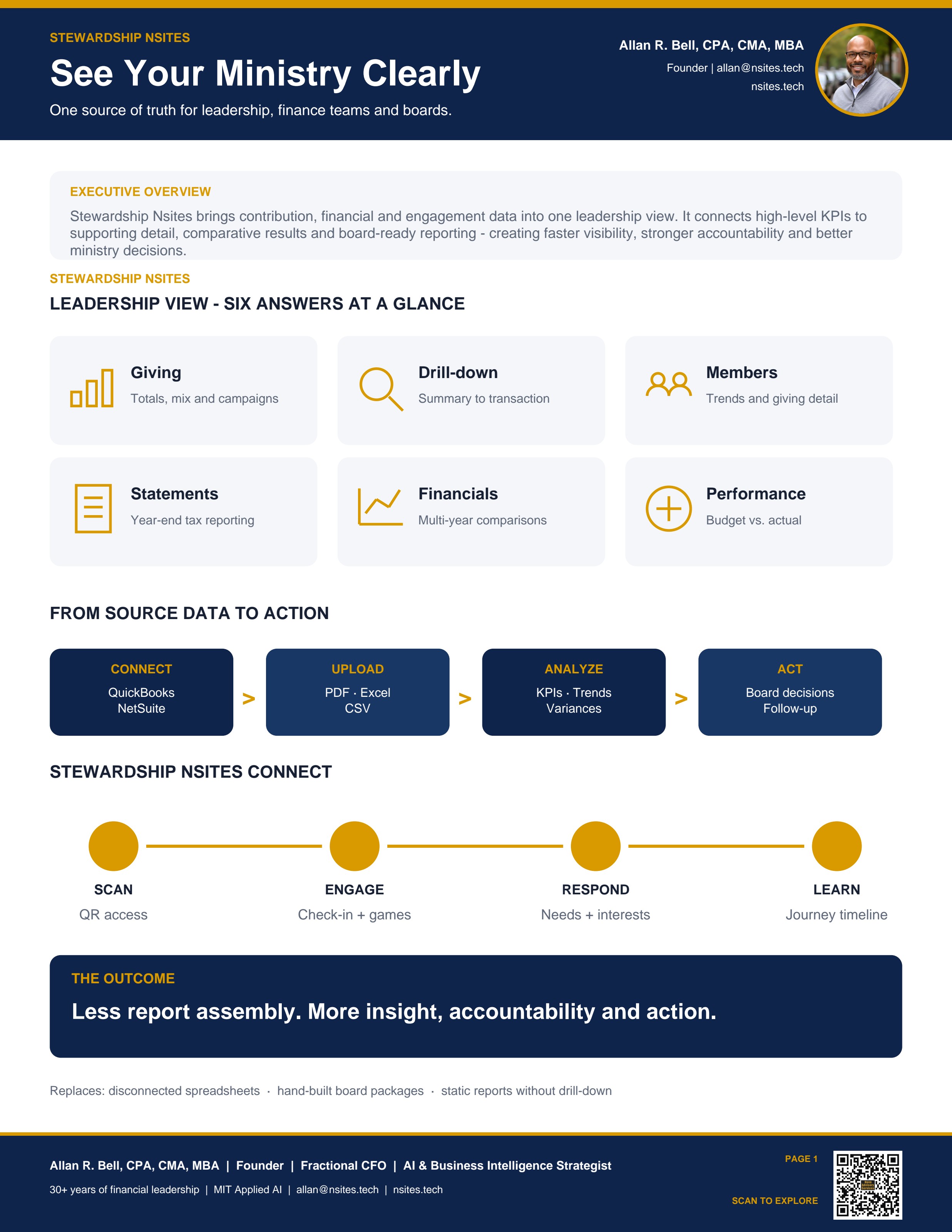
Brings contribution, financial and engagement data into one leadership view, from high-level KPIs down to the transaction that produced them.
Evidence it contributes: Giving totals and mix, budget versus actual, operating runway, giver concentration, digital adoption, multi-year comparisons and board-ready reporting.
Open Stewardship NsitesStewardship Nsites Connect
Members and guests, on their phones
Scan-to-check-in, engagement games, needs and interest responses and a journey timeline, so connection is recorded as it happens rather than guessed at later.
Evidence it contributes: Attendance and check-in patterns, first-time guest follow-up, small group and serving participation, expressed needs and interests, and connection journey movement.
Open Stewardship Nsites ConnectPersonal Nsites
Individual households, privately
A household's own financial wellness journey: assessment, readiness score, plan, goals, learning library and coaching — owned by the household, not the church.
Evidence it contributes: Aggregate, de-identified household participation and readiness movement only. No individual household financial data ever reaches church leadership.
Open Personal NsitesStewardship Nsites — illustrative examples
Sample pages showing what leadership sees. All figures are illustrative sample data.
Executive overview
How contribution, financial and engagement data come together in one leadership view.
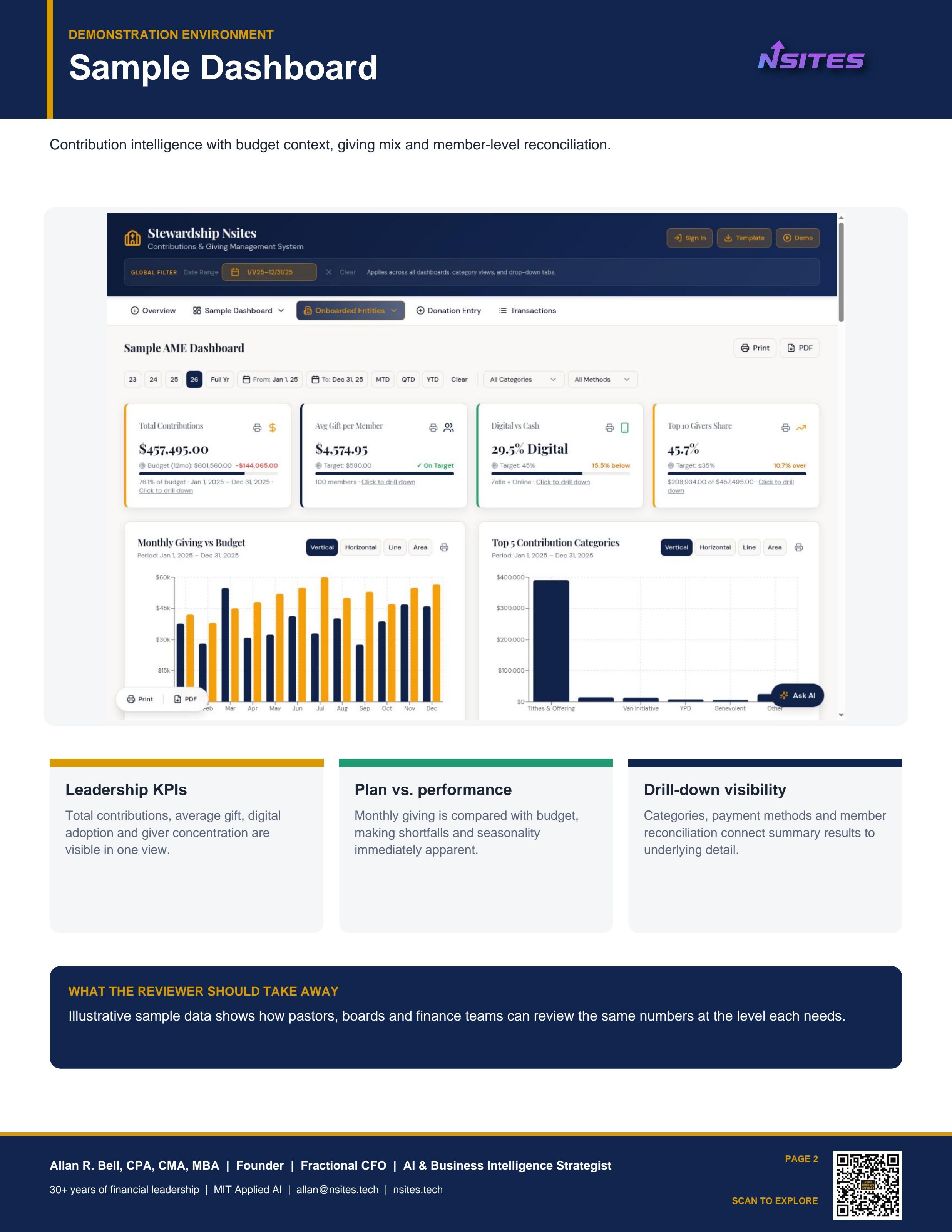
Sample dashboard
Giving totals against budget, giving mix, digital adoption and giver concentration.
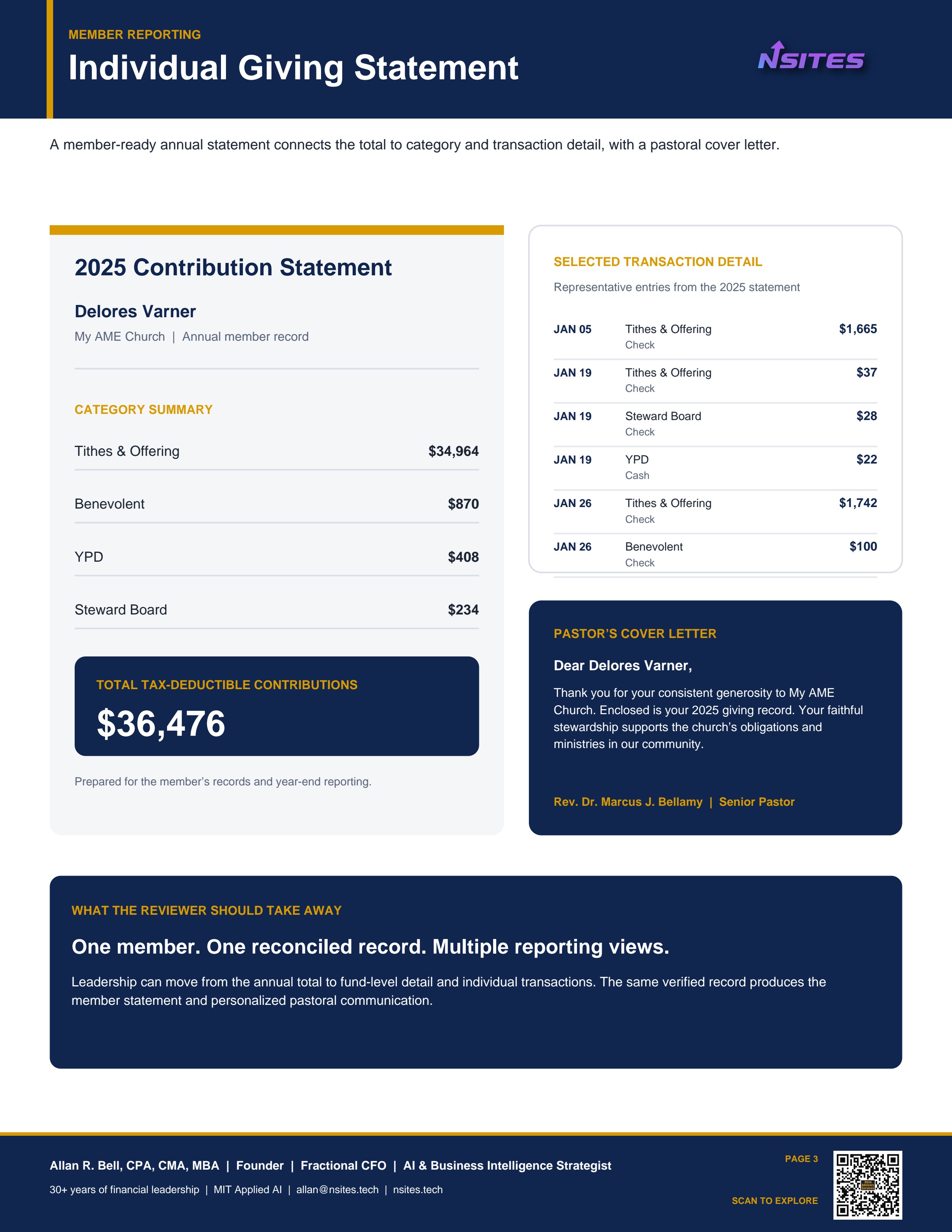
Individual giving statement
A member-ready annual statement with category and transaction detail and a pastoral cover letter.
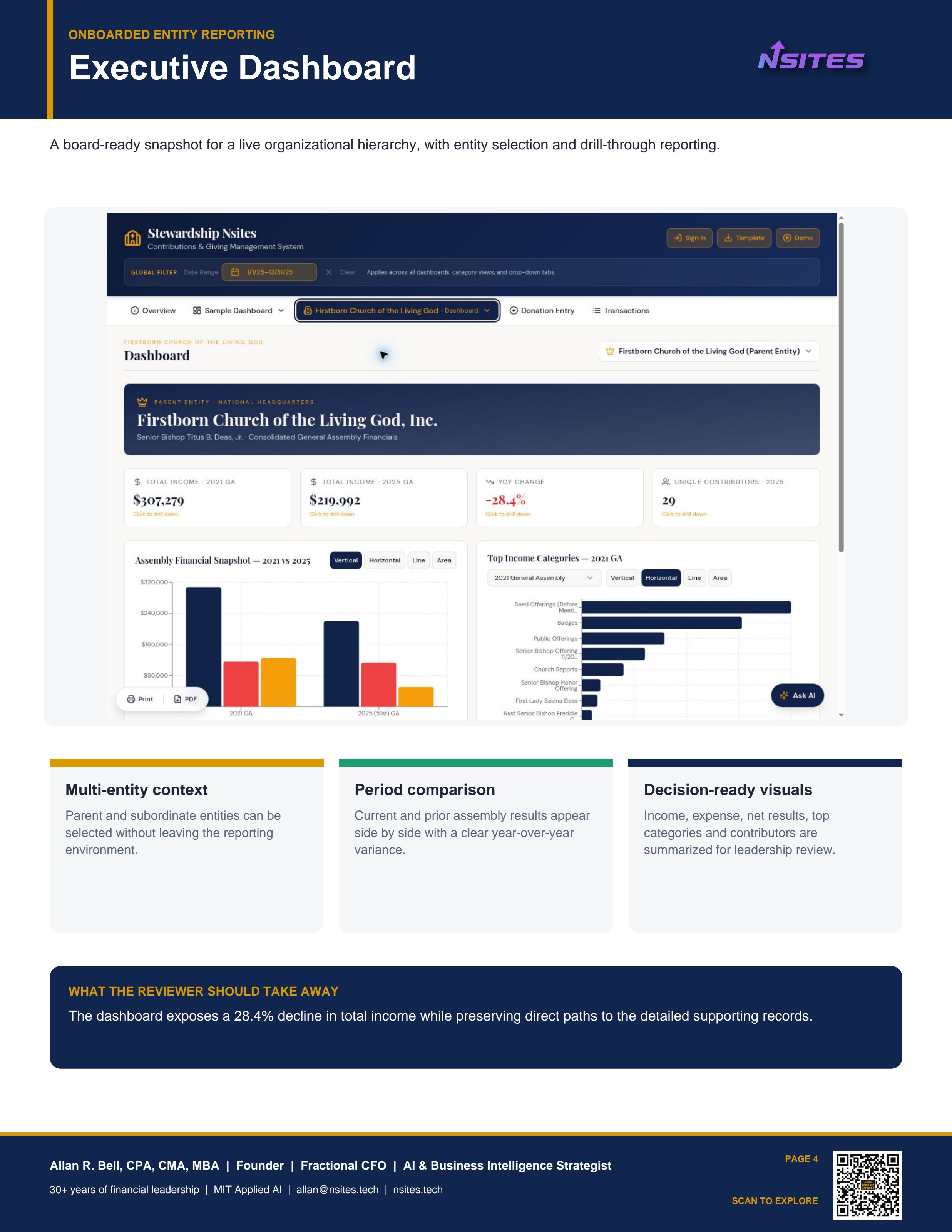
Executive dashboard
Multi-entity selection with period comparison and drill-through to supporting records.
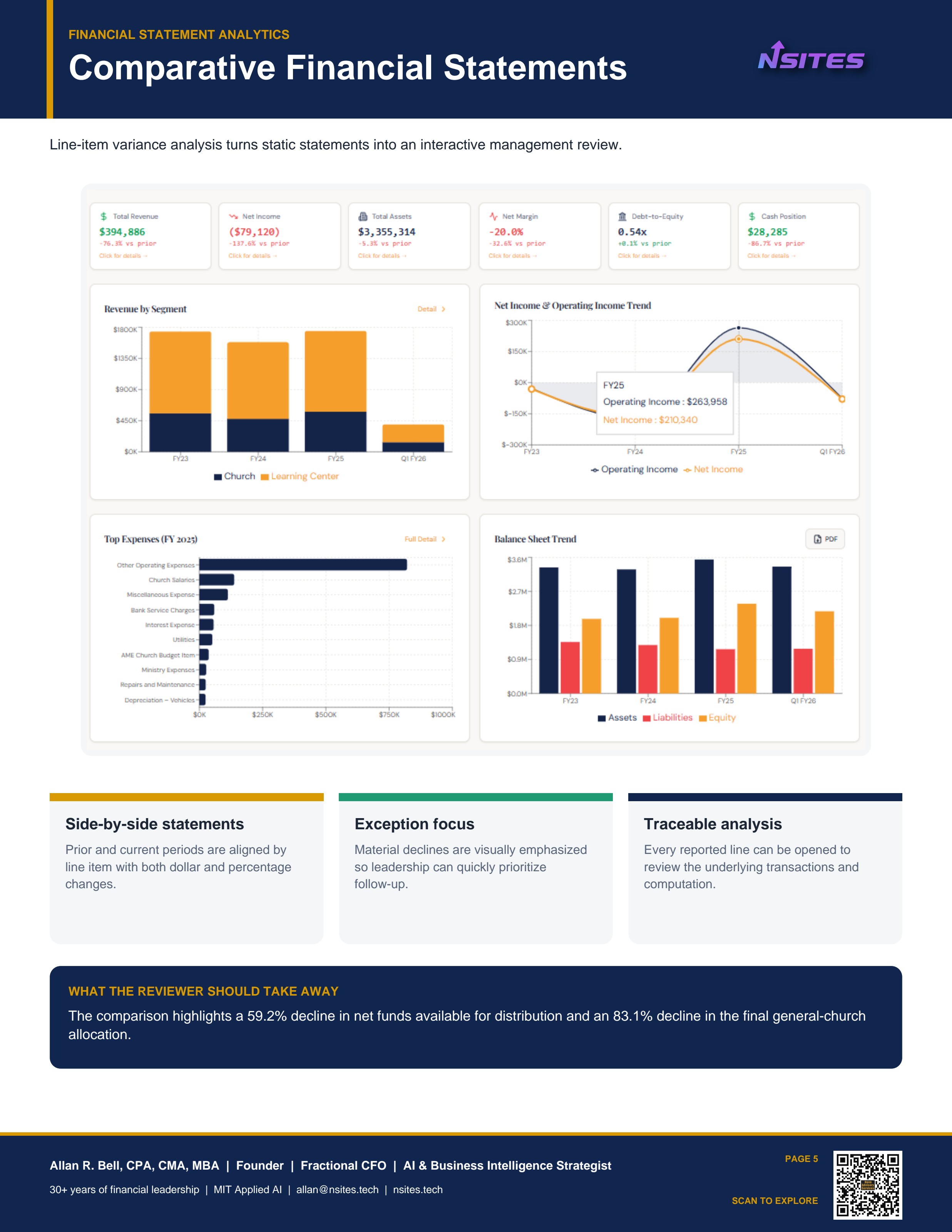
Comparative financial statements
Line-item variance analysis with traceable detail behind every reported line.
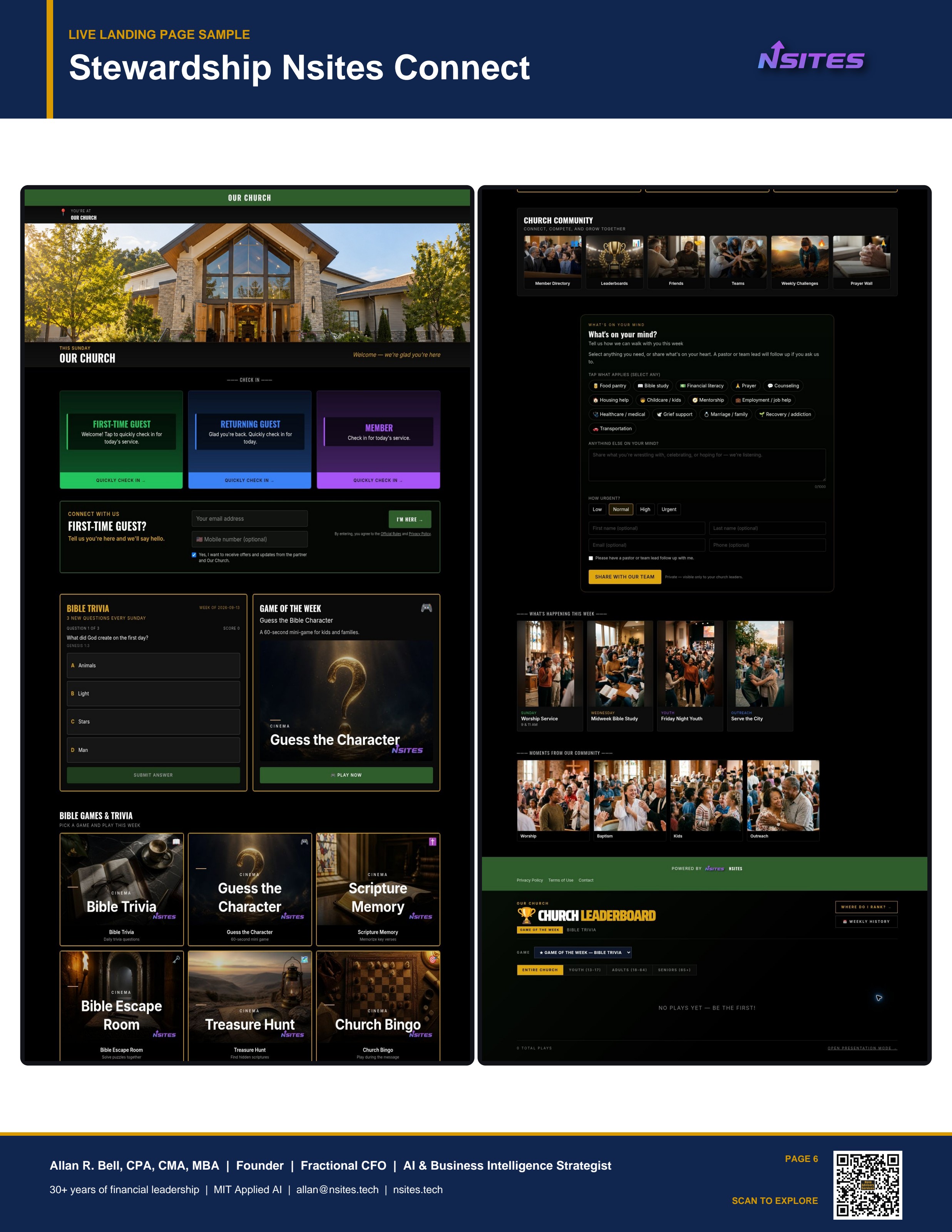
Stewardship Nsites Connect — one-page summary
The reference sheet for Connect: scan to check in, engage, respond with needs and interests, and follow the journey timeline — plus the member directory, teams, weekly challenges, leaderboard and prayer wall.
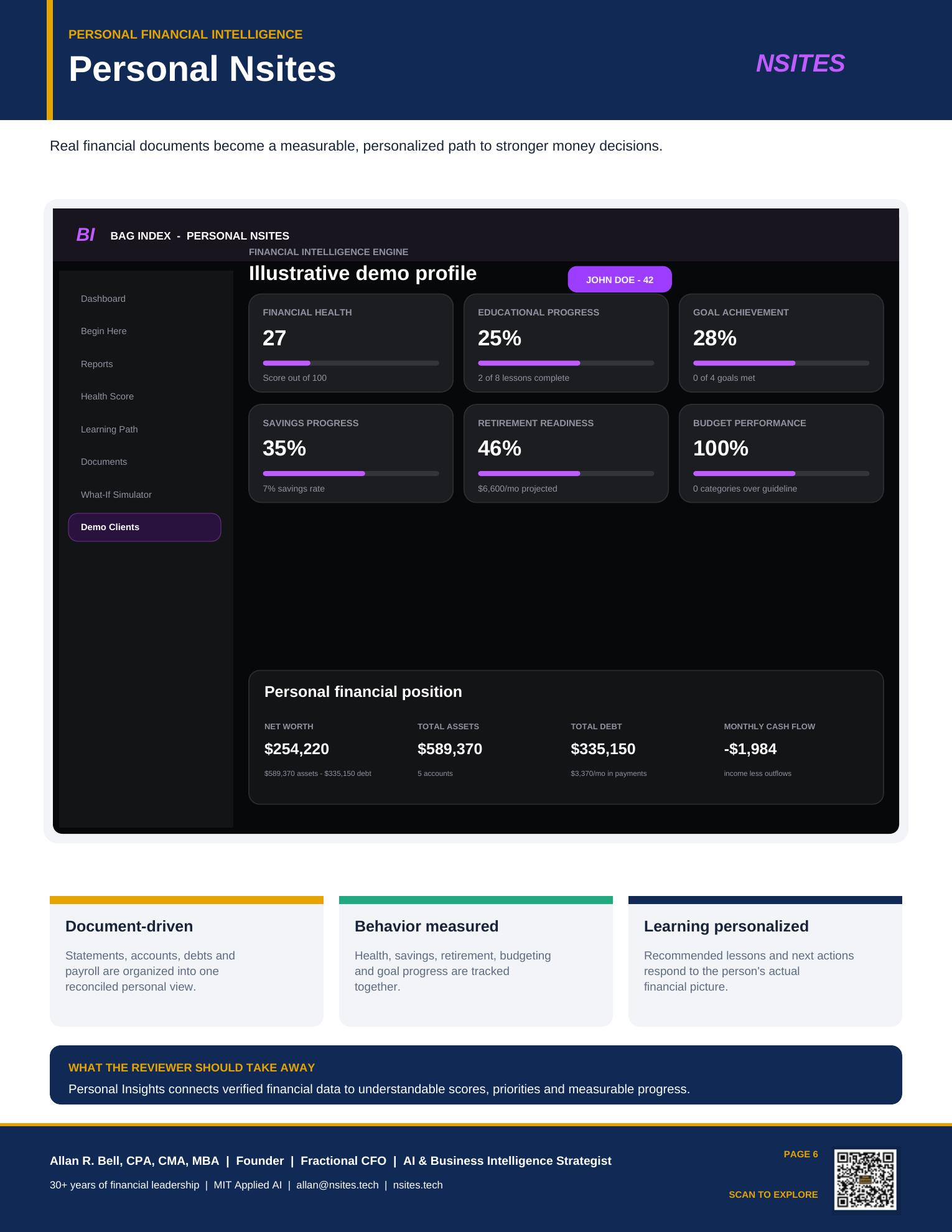
Personal Nsites — illustrative overview
These two pages show the private household experience and how documents become a personal action plan. Church leadership only ever sees aggregate, de-identified participation and movement — never an individual household's finances.
Personal Nsites overview
How real financial documents become a measurable, personalized path to stronger money decisions.
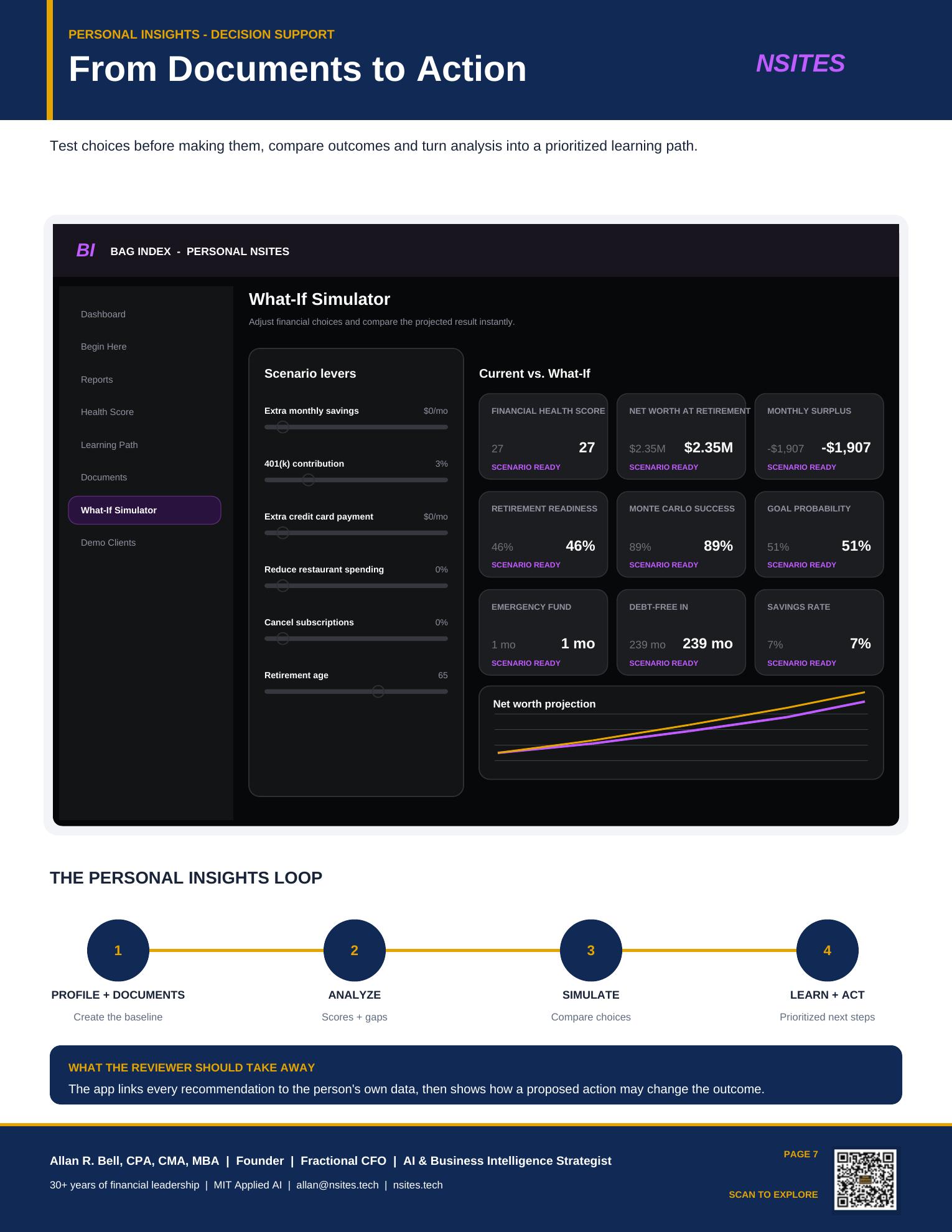
From documents to action
The personal financial loop from private documents through analysis, comparison and an updated plan.
- Financial Wellness Assessment
Where a household establishes its own starting point.
- Readiness Score
The household's own measure of financial readiness over time.
- Personal Financial Plan
Budget, debt, savings and giving capacity in one household plan.
- Learning Library
The teaching households work through between coaching sessions.
Glossary
Every key term taught in the curriculum — 113 terms harvested from all 36 lessons, de-duplicated and listed alphabetically with the modules they come from.
0–9
- 30-day check-in
- A deliberate follow-up conversation held roughly one month after a volunteer begins serving, to confirm fit and surface concerns early.
- M8 · L2
- 90-day action plan
- A near-term schedule of specific actions, owners, due dates and review dates for closing the gaps identified across the module.
- M1 · L4
A
- Accessibility and safety findings log
- A documented record of specific accessibility and safety issues, each with a corrective action, owner, and target date.
- M5 · L4
- Accessibility role
- A hospitality function specifically responsible for identifying and meeting the needs of guests with mobility, vision, hearing, or other access needs.
- M5 · L2
- Accountability Dashboard
- A tracking tool showing an initiative's owner and expected status at 30, 60, and 90 days.
- M2 · L3
- Activity list
- The current programs and ministries a church runs, which may or may not clearly serve its stated mission.
- M1 · L1
- Alignment and Opportunity Analysis
- A comparison of community need against current ministry activity that reveals matches, partial matches and unmet gaps.
- M1 · L3
- Approval threshold
- The point, often a dollar amount, above which a decision requires sign-off from a higher authority.
- M2 · L2M3 · L4
- Asset inventory
- A documented list of tangible resources such as facilities, equipment or land available to support ministry.
- M1 · L2
- Asset mapping
- The practice of identifying existing community strengths, institutions and relationships alongside documented needs.
- M9 · L2
B
- Barrier log
- A documented list of specific points of confusion or friction a visitor could encounter, each rated by severity.
- M4 · L2
- Belonging journey
- The sequence of stages a person moves through from first contact with the church to active, contributing membership.
- M6 · L1
- Brand consistency
- The degree to which visual identity (logo, colors, photography) and verbal tone match across every channel a visitor might encounter.
- M4 · L2
C
- Calling
- A person's sense that they are meant to contribute in a particular way, distinct from simple availability.
- M8 · L1
- Campaign Measurement Plan
- A document defining visitor-source categories, conversion stages and a review rhythm for evaluating communication activity against actual outcomes.
- M4 · L4
- Cash-flow forecast
- A month-by-month projection of expected income and expenses used to anticipate shortfalls or surpluses before they occur.
- M3 · L3
- Channel strategy
- A deliberate plan matching each communication channel to the audience most likely to encounter it there.
- M4 · L3
- Checklist
- A short list of checkable actions a volunteer uses before or during their shift to confirm readiness and consistency with the standard.
- M5 · L2
- Church fingerprint
- The unique combination of gifts, experience, assets, relationships and demonstrated impact that distinguishes one congregation from another.
- M1 · L2
- Community voice
- Priorities and perspectives gathered directly from residents and stakeholders of the community the church hopes to serve.
- M9 · L2
- Consent language
- Plain-language wording that tells a guest what will be done with information they share and confirms their ability to decline further contact.
- M6 · L2
- Consented-story standard
- A documented practice requiring informed, specific and revocable consent before sharing a beneficiary's story, photo or likeness publicly.
- M9 · L4
- Content calendar
- A scheduled plan of upcoming communications naming audience, purpose, channel, owner, call to action and success measure for each item.
- M4 · L3
- Conversion stages
- The defined sequence of steps a person moves through from first awareness of the church to ongoing, engaged participation.
- M4 · L4
- Core message
- The single sentence that most accurately and honestly describes what the church is and what it offers, stated so a newcomer understands it immediately.
- M4 · L1
- Covenant membership
- A formal, mutual commitment between a person and the local church, typically involving shared belief, participation and accountability.
- M6 · L3
D
- Decision rights
- The specific authority to recommend, decide, execute, approve, or be informed about a given decision.
- M2 · L2
- Demographic information
- Measurable population characteristics such as age, income and household composition.
- M1 · L3
- Demonstrated impact
- Specific, evidenced outcomes a church has produced, as opposed to aspirational claims about what it hopes to accomplish.
- M1 · L2
- Digital front door
- The website, search listing and social media profiles a first-time visitor encounters before ever physically arriving at the church.
- M4 · L2
- Duplication
- Two or more formation environments serving essentially the same stage and purpose without coordination between the ministries running them.
- M7 · L2
E
- Executive leadership
- The person or team responsible for translating governance decisions into organizational action.
- M2 · L1
F
- Financial visibility
- The degree to which accurate, timely financial information reaches the people responsible for making decisions, not just the person who keeps the books.
- M3 · L1
- Fit
- The match between a person's actual skills and temperament and the real requirements of a ministry role.
- M8 · L1
- Formation Environment Inventory
- A complete listing of every current class, group, mentoring relationship, and care practice, mapped against maturity stages.
- M7 · L2
- Friction point
- A specific stage in the guest journey where confusion, delay, or discomfort is likely to occur.
- M5 · L1
- Funnel review
- A recurring leadership meeting that reviews the entire belonging journey for patterns of drop-off across every stage.
- M6 · L4
G
- Giving concentration
- The share of total giving contributed by the top-giving households, used as an indicator of financial fragility.
- M3 · L2
- Governance body
- The board, elder council, or trustees accountable for legal, financial, and strategic direction.
- M2 · L1
- Guest journey
- The full sequence of stages a guest experiences on a Sunday, from arrival in the parking lot through departure and any follow-up contact.
- M5 · L1
- Guest type
- A category of visitor defined by how they arrived or what need they expressed, used to determine the appropriate follow-up path.
- M6 · L2
I
- Insider language
- Phrases, ministry names or theological shorthand that only make sense to people already familiar with the church or with Christian culture.
- M4 · L1
- Integration Point
- A specific area of church life, such as preaching, groups, households, care, leadership, or service, where formation can be intentionally woven in rather than isolated.
- M7 · L4
- Intended result
- The specific, statable change an activity is designed to produce for the people or partner it serves.
- M9 · L1
- Intentional feedback channel
- A designed, ongoing way of gathering guest or member feedback, as opposed to feedback that arrives only by chance.
- M5 · L4
- Interpretation Limit
- A stated sentence describing what a given metric cannot tell you, printed directly alongside it on the dashboard.
- M7 · L3
K
- Key-person dependency
- A situation where critical knowledge, access, or relationships exist with only one individual, creating organizational risk if that person is unavailable.
- M2 · L4
L
- Lapse signal
- A specific, observable change in attendance, giving or serving pattern that indicates a person may be disengaging.
- M6 · L4
- Leader Pipeline
- A documented list of specific people at different readiness stages being intentionally developed toward future ministry leadership.
- M8 · L4
- Leader-Development Bridge
- The named, intentional transition point where a maturing disciple is invited into a leadership role, defined by specific criteria and a responsible person.
- M7 · L4
- Leadership Alignment Map
- A visual or tabular record of where leaders' independent mission answers converge and diverge.
- M1 · L1
- Leadership-team standards
- Written agreements about how a leadership team communicates, handles conflict, and holds one another accountable.
- M2 · L4
- Local mission
- The specific expression of the universal purpose that this particular congregation is called to live out in its context.
- M1 · L1
M
- Maturity Definition
- A church-specific, biblically grounded description, drafted for pastoral review, of what growth toward Christlikeness looks like in this congregation.
- M7 · L1
- Maturity Profile
- A worksheet listing observable, stage-appropriate indicators of growth used to guide pastoral conversation, not to rank individuals.
- M7 · L1
- Meeting audit
- A review of all current recurring meetings to identify overlap, gaps, and alignment with actual decision needs.
- M2 · L3
- Meeting rhythm
- A documented, layered cadence of meetings, each with a defined purpose and frequency, that together cover execution, coordination, and governance.
- M2 · L3
- Membership Expectations Summary
- A concise, plain-language document describing what is expected of members and what members can expect from the church.
- M6 · L3
- Message Framework
- A one-page document stating the church's core message in plain language plus supporting messages tailored to specific audiences.
- M4 · L1
- Ministry Scorecard
- A one-page document defining a ministry's purpose, key outcome measures and current health status.
- M8 · L4
- Mission Decision Filter
- A short, repeatable set of questions leadership applies to new ministry proposals to test alignment with mission, fingerprint and current priorities.
- M1 · L4
- Mission-aligned strategy
- A reasoned set of decisions about which needs a church will address and why, from which specific activities follow.
- M9 · L1
- Monthly Experience Review
- A short, recurring meeting that reviews guest and volunteer feedback, checks hospitality standards, and produces action items each month.
- M5 · L4
O
- Operating runway
- The number of months a church could continue paying its normal operating expenses if income stopped, based on current cash and reserves.
- M3 · L1M3 · L3
- Opportunity Catalog
- A documented, categorized list of every active ministry role describing its purpose, skills, commitment, screening, training and responsible leader.
- M8 · L1
- Orientation agenda
- The structured sequence of topics covered in the session or class that prepares a person for informed membership commitment.
- M6 · L3
- Orphan decision
- A recurring church decision that does not clearly belong to any documented layer of authority.
- M2 · L1
- Outcome measure
- An indicator of whether a ministry is actually accomplishing its underlying purpose, as distinct from simple activity counts.
- M8 · L4M9 · L4
- Output measure
- A count of activity performed, such as people served, sessions held or funds distributed.
- M9 · L4
- Outreach activity
- A discrete action the church takes to serve, evangelize or partner beyond its membership, such as an event, trip or disbursement.
- M9 · L1
- Ownership gap
- A segment of the service where no one is clearly responsible for its timing and handoff to the next segment.
- M5 · L3
P
- Participation Indicator
- A measurable data point such as attendance, class completion, or group involvement that is easy to gather at scale but limited in what it reveals.
- M7 · L3
- Participation rate
- The percentage of active giving households that made at least one gift during a defined period.
- M3 · L2
- Partner strength
- A scored assessment of an external organization's track record, competence and financial and operational transparency.
- M9 · L3
- Pastoral care of volunteers
- Genuine attention to a volunteer as a whole person, including awareness of changing life circumstances affecting their capacity to serve.
- M8 · L3
- Pastoral Indicator
- A relational observation, gathered through conversation, such as whether someone has a next step in mind or a person to call in crisis.
- M7 · L3
- Pastoral Signal
- A piece of observable or participation data that prompts a pastoral question or conversation rather than serving as a conclusion about someone's spiritual condition.
- M7 · L1
- Pathway Map
- A visual arrangement of formation environments showing the progression a person would follow from newcomer toward maturing disciple.
- M7 · L2
- Placement Standards
- The documented criteria and approval authority required before a volunteer is confirmed into a specific role.
- M8 · L2
- Policy register
- A documented inventory of a church's policies by area, noting which exist, are missing, or are outdated.
- M2 · L4
- Portfolio balance
- A deliberate mix of local, regional and global mission commitments that a church can explain and defend, rather than an accidental accumulation.
- M9 · L3
- Poverty-tourism framing
- A pattern in which outreach communication treats beneficiaries as helpless objects of charity rather than neighbors with dignity and agency.
- M9 · L2
- Priority audience
- The specific group of people the church's fingerprint and the community's need most clearly position it to serve well.
- M1 · L3
- Psychographic information
- Attitudes, concerns, values and lifestyle patterns of people in the community, typically gathered through observation and relationship.
- M1 · L3
R
- Re-engagement pathway
- The defined process, including owner and message tone, used to reach out to someone showing a lapse signal.
- M6 · L4
- Ready-now leader
- A person who could step into a leadership role today if a vacancy opened, based on demonstrated readiness.
- M8 · L4
- Recognition
- Specific, timely acknowledgment of a volunteer's actual contribution, distinct from generic annual appreciation events.
- M8 · L3
- Reconciliation
- The process of matching recorded financial transactions against bank statements to confirm the books are accurate.
- M3 · L1
- Recurring-giving share
- The portion of total giving that arrives through scheduled recurring gifts rather than one-time gifts.
- M3 · L2
- Remediation register
- A tracked list of identified control gaps, each with a recommended fix, an owner, and a target date.
- M3 · L4
- Reserves policy
- A written statement of a church's target reserve level, the conditions for drawing on it, and how it will be replenished.
- M3 · L3
- Retention risk
- A specific, evidence-based pattern likely to cause volunteers to disengage or quit if left unaddressed.
- M8 · L3
- Role scorecard
- A short document naming a role's core responsibilities, authority boundaries, and success measures.
- M2 · L2
S
- Safeguarding expectation
- A documented, general standard for protecting the wellbeing and dignity of children, vulnerable adults or beneficiaries involved in an activity.
- M9 · L3
- Screening tier
- A risk-based level of background or reference checking applied to a ministry role, scaled to the vulnerability of those it serves.
- M8 · L1
- Secret-guest walkthrough
- An intentional visit by someone unfamiliar with the church, conducted to observe and document the guest experience as it actually happens.
- M5 · L1
- Separation of duties
- Structuring financial tasks so that no single person controls a process from start to finish, reducing risk of error or misuse.
- M3 · L4
- Service standard
- A written, observable description of what excellent performance looks like in a specific hospitality role.
- M5 · L2
- Service timeline
- A segment-by-segment record of the service's planned and actual timing, with an owner named for each segment.
- M5 · L3
- Shadow experience
- A period in which a new volunteer serves alongside an experienced volunteer before serving independently.
- M8 · L2
- Spiritual oversight
- The pastoral and elder responsibility for doctrine, discipline, and the spiritual health of the congregation.
- M2 · L1
- Stage conversion measure
- A specific, trackable percentage or count that shows how many people move from one stage of the journey to the next.
- M6 · L1
- Stuck point
- A stage in the journey where people commonly stall or disengage before moving forward.
- M6 · L1
T
- Three-year vision
- A short, vivid description of the future state leadership is pursuing over the next three years, grounded in mission, fingerprint and priority audience.
- M1 · L4
- Timing window
- The maximum number of days allowed before a follow-up contact must occur for a given guest type.
- M6 · L2
- Training refresher
- Ongoing skill development offered to an existing volunteer so their role can grow rather than stagnate.
- M8 · L3
- Twelve-Month Formation Rhythm
- A year-long plan assigning specific formation improvements, tied to the pathway's largest named gaps, across quarters and integration points.
- M7 · L4
- Twelve-month priorities
- Three to five specific, owned and measurable steps toward the three-year vision, chosen from among many possible good ideas.
- M1 · L4
U
- Universal purpose
- The calling shared by every Christian church, regardless of location, size or tradition.
- M1 · L1